
 |
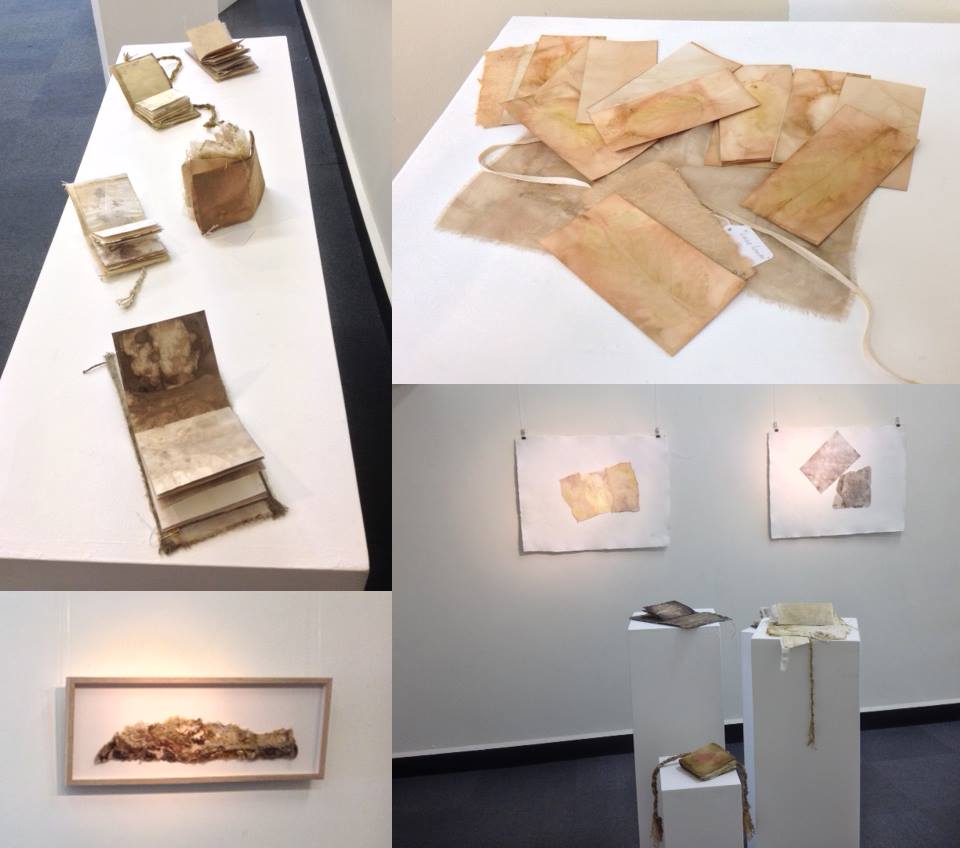
| A montage of images of part of this exhibition. |
Here is a record of the label info for this exhibition:
"The State of Play - Exploratory Makings" Viv Davy October 2017.
The Landscape Series.
These works were inspired by the variety of landscapes around the coast in Southern Taranaki - the volcanic jumbles of differing types of rocks and soils that have been exposed to the action of the ocean. Such a wide range of differing evidences of previous formations that have been exposed to resorting and re-depositing by geological and man made events remind me of earth's fragility and fugitive nature. Evoking this through the use of "soft" materials has been for me, as an artist, an exploration in emotionally imbedding personhood into a geological context. All the materials used are natural - wools, silks, cottons, jutes, papers; they have all been coloured using locally sourced botanical and metallic dye extracts. This has provided an "organic" and living palette and texture to the making. 2017
1. "Cliff"
Materials:
Wools, silks, cottons, hemps, papers, conservation grade adhesive and mounting systems, Museum glass to provide UV protection ensuring pigment stability.
Price: $480.00.


2. "Topography"
Materials:
Wools, silks, cottons, hemps, papers, conservation grade adhesive and mounting systems, Museum glass to provide UV protection ensuring pigment stability.
Price: $420.00
-------------------------------------------------------------------------------------------------------
The Spring Series
In spring the continuous rapid growth of plants in South Taranaki constantly impresses me. Despite storm battering and volatile conditions there is a great power of growth. The new growth can appear in random places and take unexpected forms but will evidence the softness of the new. Buds and shoots emergent, changing form and colour in rapid flow. 2017
These works were inspired by the variety of landscapes around the coast in Southern Taranaki - the volcanic jumbles of differing types of rocks and soils that have been exposed to the action of the ocean. Such a wide range of differing evidences of previous formations that have been exposed to resorting and re-depositing by geological and man made events remind me of earth's fragility and fugitive nature. Evoking this through the use of "soft" materials has been for me, as an artist, an exploration in emotionally imbedding personhood into a geological context. All the materials used are natural - wools, silks, cottons, jutes, papers; they have all been coloured using locally sourced botanical and metallic dye extracts. This has provided an "organic" and living palette and texture to the making. 2017
1. "Cliff"
Materials:
Wools, silks, cottons, hemps, papers, conservation grade adhesive and mounting systems, Museum glass to provide UV protection ensuring pigment stability.
Price: $480.00.


2. "Topography"
Materials:
Wools, silks, cottons, hemps, papers, conservation grade adhesive and mounting systems, Museum glass to provide UV protection ensuring pigment stability.
Price: $420.00
-------------------------------------------------------------------------------------------------------
The Spring Series
In spring the continuous rapid growth of plants in South Taranaki constantly impresses me. Despite storm battering and volatile conditions there is a great power of growth. The new growth can appear in random places and take unexpected forms but will evidence the softness of the new. Buds and shoots emergent, changing form and colour in rapid flow. 2017
1. "Delicate"
Materials:
Papers, silks, botanical extract dye washes. UV protective glass.
Price: $200.00
2. "Emergent"
Materials:
Papers, silks, botanical extract dye washes. UV protective glass.
Price: $200.00
3. "Transitory"
Materials:
Papers, silks, botanical extract dye washes. UV protective Conservation glass.
Price: $200.00
-------------------------------------------------------------------------------------------------------
The Ephemera Series
Mists, low clouds, sea sprays, sea fogs, soft rains. The light and the moisture is so fugitive and volatile on the coast of South Taranaki, especially early in the mornings when the world is still to be truly coloured in by the daylight. 2017
Ephemera I - V
Materials:
Handmade silk and cotton rag paper, silk cocoon. UV protective Conservation glass.
Price: $160.00 each.
-------------------------------------------------------------------------------------------------------
"Earth's"
A response to the colours, contours, textures and organic forms in the bands and layers in our landscapes. 2017
Materials:
Silk Voile, wool flannel, silk threads, contact botanical and metal dyes. UV protective Conservation glass.
Papers, silks, botanical extract dye washes. UV protective glass.
Price: $200.00
2. "Emergent"
Materials:
Papers, silks, botanical extract dye washes. UV protective glass.
Price: $200.00
3. "Transitory"
Materials:
Papers, silks, botanical extract dye washes. UV protective Conservation glass.
Price: $200.00
-------------------------------------------------------------------------------------------------------
The Ephemera Series
Mists, low clouds, sea sprays, sea fogs, soft rains. The light and the moisture is so fugitive and volatile on the coast of South Taranaki, especially early in the mornings when the world is still to be truly coloured in by the daylight. 2017
Ephemera I - V
Materials:
Handmade silk and cotton rag paper, silk cocoon. UV protective Conservation glass.
Price: $160.00 each.
-------------------------------------------------------------------------------------------------------
"Earth's"
A response to the colours, contours, textures and organic forms in the bands and layers in our landscapes. 2017
Materials:
Silk Voile, wool flannel, silk threads, contact botanical and metal dyes. UV protective Conservation glass.
Price: $250.00.


-------------------------------------------------------------------------------------------------------
The Sequential Series
These pieces reflect the transition of our world through time - the imprints that are our existences that gradually evolve and fade, leaving a greater or lesser imprint on the surrounds. The botanical contact printing method is used to describe the uniqueness of each contact, creating a memory statement. 2016.
"Sequential I".
Materials:
Silk, contact botanical printing, felt,
Price: $380.00
"Sequential II".
Materials:
Silk, contact botanical printing, felt,
Price: $380.00
----------------------------------------------------------------------------------------------------------
"Day Break"
The sight of the new morning golden glow is the occasional reward for being an early riser, the light bringing the warmth.
Materials:
Handmade Indian Cotton Rag Acid Free Paper, other handmade papers, floral extract washes.
Price: $210.00
-------------------------------------------------------------------------------------------------------
"Old Remains"
Evidences are left in the landscapes, especially on the cliffs and beaches where old rubbish dumps existed. The passage of time uncovers their existence, exposing the remains. Like letters from the past these relics evidence us.
Materials:
Handmade Indian Cotton Rag Acid Free Paper, cartridge paper and envelope, botanical contact print with metallic elements.
Price: $210.00
The Sequential Series
These pieces reflect the transition of our world through time - the imprints that are our existences that gradually evolve and fade, leaving a greater or lesser imprint on the surrounds. The botanical contact printing method is used to describe the uniqueness of each contact, creating a memory statement. 2016.
"Sequential I".
Materials:
Silk, contact botanical printing, felt,
Price: $380.00
"Sequential II".
Materials:
Silk, contact botanical printing, felt,
Price: $380.00
----------------------------------------------------------------------------------------------------------
"Day Break"
The sight of the new morning golden glow is the occasional reward for being an early riser, the light bringing the warmth.
Materials:
Handmade Indian Cotton Rag Acid Free Paper, other handmade papers, floral extract washes.
Price: $210.00
-------------------------------------------------------------------------------------------------------
"Old Remains"
Evidences are left in the landscapes, especially on the cliffs and beaches where old rubbish dumps existed. The passage of time uncovers their existence, exposing the remains. Like letters from the past these relics evidence us.
Materials:
Handmade Indian Cotton Rag Acid Free Paper, cartridge paper and envelope, botanical contact print with metallic elements.
Price: $210.00
-------------------------------------------------------------------------------------------------------
"Loose Leaves"
Cherry trees provided the print and colour for this collection of unbound pages. I have left them loosely bundled to resonate with the wind shaking these leaves free once the tree is done with them. They are our autumnal treasures, to be considered in their unrepeatable individual beauty. A site for contemplation.
Materials:
Papers, botanical contact printing, silk voile and silk ribbon.
-------------------------------------------------------------------------------------------------------
Book Collections
Intimate
Tactile
Sensory
Contemplative.
All the colours and materials used in these book forms are natural, capturing life essences.
-------------------------------------------------------------------------------------------------------
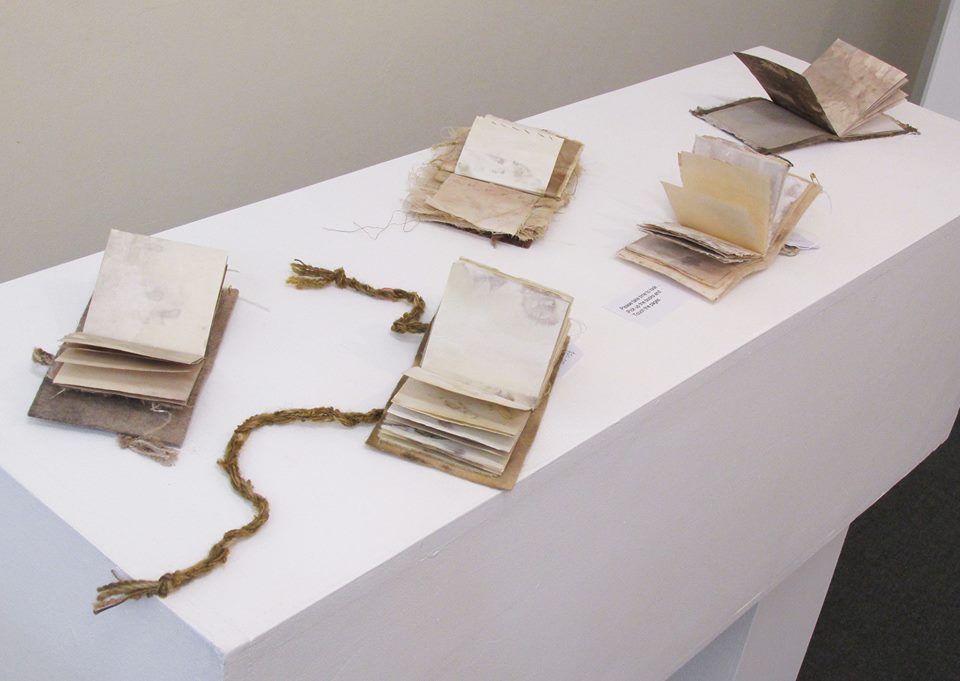
"Hand Books"
These tiny "Hand Books" have been created as mindfulness vessels. Carry them with you, open when needing to find stillness, contemplate the pages, perhaps record on the pages or just allow them to refocus your thoughts, feel, relax, embrace.
Individually priced on items.
-------------------------------------------------------------------------------------------------------
"Wild Ones"
These vessels are inspired by the vigour and energy of the physical environment in South Taranaki. We, as occupiers and custodians, constantly strive to impose a sense of containment and order in this place, to be repeatedly thwarted. The elements are powerful - the winds, the rain, the ocean, all exert their natures in multiple manifestations. Our efforts are so often overlaid or redefined by this power.
The book form has traditionally been tightly bound, restrained within covers. These "Wild Ones" reconstruct that premise to speak about South Taranaki - unrestrained, spontaneous, and resolutely wild.
Use a "Wild One" to refocus on nature through visual engagement or use it to create a record. Be free.
Individually priced on items.


-------------------------------------------------------------------------------------------------------
"Practicality Series"
Human life in South Taranaki is informed to a great extent by practical pragmatism. In honour of the ordered and organised nature of this aspect of life in this region I created the "Practicality Series". These booklets are easy to recognise and use while allowing for distinctive creative expressions. Individually priced on items.
Cherry trees provided the print and colour for this collection of unbound pages. I have left them loosely bundled to resonate with the wind shaking these leaves free once the tree is done with them. They are our autumnal treasures, to be considered in their unrepeatable individual beauty. A site for contemplation.
Materials:
Papers, botanical contact printing, silk voile and silk ribbon.
-------------------------------------------------------------------------------------------------------
Book Collections
Intimate
Tactile
Sensory
Contemplative.
All the colours and materials used in these book forms are natural, capturing life essences.
-------------------------------------------------------------------------------------------------------
"Hand Books"
These tiny "Hand Books" have been created as mindfulness vessels. Carry them with you, open when needing to find stillness, contemplate the pages, perhaps record on the pages or just allow them to refocus your thoughts, feel, relax, embrace.
Individually priced on items.
-------------------------------------------------------------------------------------------------------
"Wild Ones"
These vessels are inspired by the vigour and energy of the physical environment in South Taranaki. We, as occupiers and custodians, constantly strive to impose a sense of containment and order in this place, to be repeatedly thwarted. The elements are powerful - the winds, the rain, the ocean, all exert their natures in multiple manifestations. Our efforts are so often overlaid or redefined by this power.
The book form has traditionally been tightly bound, restrained within covers. These "Wild Ones" reconstruct that premise to speak about South Taranaki - unrestrained, spontaneous, and resolutely wild.
Use a "Wild One" to refocus on nature through visual engagement or use it to create a record. Be free.
Individually priced on items.


-------------------------------------------------------------------------------------------------------
"Practicality Series"
Human life in South Taranaki is informed to a great extent by practical pragmatism. In honour of the ordered and organised nature of this aspect of life in this region I created the "Practicality Series". These booklets are easy to recognise and use while allowing for distinctive creative expressions. Individually priced on items.
-------------------------------------------------------------------------------------------------------
"Landscape Series"
The feature pages in these books are small scale collage 'landscapes'. These are intimate works arising out of creating "Cliff" and "Topography". Individually priced on items.

-------------------------------------------------------------------------------------------------------
Light Catchers
Created to hang freely within a space or window, these copper wire forms will move with air currents and capture light, then create shadows. These pieces embrace the richness of the light in South Taranaki, which is so striking and changeable.
Price: $100.00 each.
"Landscape Series"
The feature pages in these books are small scale collage 'landscapes'. These are intimate works arising out of creating "Cliff" and "Topography". Individually priced on items.

-------------------------------------------------------------------------------------------------------
Light Catchers
Created to hang freely within a space or window, these copper wire forms will move with air currents and capture light, then create shadows. These pieces embrace the richness of the light in South Taranaki, which is so striking and changeable.
Price: $100.00 each.
Spending time this afternoon preparing my speech - presentation for this, tomorrow.
Here are the notes I have made - they hold important thoughts about the botanical pressure or contact printing system as well as the handmade books.
Speech notes.
Talk Notes for 14
October 2017. L W Gallery
Good morning everyone, thank you so much for coming and also thanks to the Gallery and its committee for facilitating this exhibition and talk.
My recent practice
research has looked at the domestic, especially investigating the idea that our
homes are the liminal sites that enable us to incorporate the public world into
our individual or private world. In doing this body of research I came to a
realization of how profoundly the surrounding physical environment influences
this liminal process in the home.
In the work on
display here I am exploring my immediate physical surroundings - allowing me to
reflect more intimately on aspects of that environment - such as waves, clouds,
soils, landforms, tides, plants and light.
The wall notes
that sit beside the exhibition pieces contain brief descriptions of some of my
thought processes informing my exploratory makings. I thought, this morning
firstly I would briefly describe how the colour used in my materials has been
derived, then I will talk about book making and we can finish up with
consideration of the works in their groupings. I am happy to answer any
questions or fill in any details that interest you so please feel free to
interrupt at any time.
I have on the bench
here a collection of some of the materials I use in my botanical contact print
process. I have become captivated by this process as it resonates with my
emotional exploration of my physical context for creating my place called home.
The delight of this process is that it is connected with physical materiality -
the results go beyond what I can control and are about what happens when
materials do "their thing". This is the reality of the South Taranaki
landscape. For all our efforts to control it, the climate and the geology are
beyond our power so we are surrounded by the results of materials doing "their
thing".
Unfortunately I am
unable to generate all the materials that I use, partly due to my skill set but
also due to time restraints. This practice is definitely defined as slow making
with many stages involved and one of the key agents being time itself. So my raw
materials, except for occasional hand-woven fabric or handmade paper are all
purchased. I only use natural materials such as silk, cotton, wool, jute, flax
and linen. Some of these are on the bench in various manifestations.
The transformation
from the white or natural coloured unmarked materials that I have put out into
the materials you see in the art work, is achieved by the use of water,
including steam, salvaged plant and mineral materials, heat, pressure and time.
Through the alchemy of these elements the materials transform. It is often
described as an eco-dying process, which it is - no commercial dye or mordant
chemicals are used. All the pigment and mordant elements are found locally,
extracted from a sustainable, bio friendly source. The plants from my own
property, the mineral sources primarily found on my walks with the dogs around South
Taranaki.
Leaves are collected,
cooked in copper or stainless vessels to release their pigments. More leaves
are interlaid with the chosen materials, embedded with mineral sources. The
contents of the bundles are held together under pressure, then placed in the
pigment baths, cooked slowly, air dried, steamed and ironed. The result is a
form of archival preservation as each impression captures a plant at a specific
time. The natural ink maker Jason Logan states that his plant colours are a
language - it is the plant telling its story. This description resonates for me
as I consider my makings in this exhibition are all narratives about South
Taranaki.
Of course the
creating of the coloured materials is just the start of the practice - these
materials are then assembled in differing ways to create the layered works that
are exhibited here. All the attachment of these materials is done by hand stitching
or by archival adhesive.
Now to just talk
briefly about my books.
The books are
small moments - sites where the beauty may look simple but when you look more
closely it is always layered and it is the layers and the consequent complexities
that create the beauty.
With these books my
aim was the enrichment of material in a form that can be portable, intimate,
personal, reflective, introspective, grounding and centering. This is what I
experience as I make them, my dream is to create such experience sites for you
as a user.
The books mark the
passage of time by the processes of slow making involved in creating and
embellishing the individual elements. Then time as an active agent is invoked
again as you hold, open and use the book - turning the pages. Focused stillness
could come or invigorating stimulus for engaging with the natural world.
Please pick the
books up and intimately engage.
So why the title
of the exhibition?
Every time I
engage in this art practice the creating of the materials is the fundamental
part and as already described this is largely controlled by the source dye and
mineral materials, the time of year, the amount of time invested in the dying
process, the way the bundles are created and the combination of elements put in
any dye bundle. Even having knowledge of likely outcomes for example knowing
that kawakawa will give a green dye bath if cooked in copper vessel, the process
I use cannot control the exact results. Elements work with each other yielding
sometimes happy surprises and sometimes disappointment. This has to be
approached as a practice of play in order for it to be sustainable; it is a
matter of letting go to a large extent.
Any questions?
Now we can look at
the works themselves. Where would you like to start?
Well the best thing about this speech was that there was just an intimate group of people at the opening so we just chatted asking questions and handling the raw materials. It was really positive, they were all very engaged and I felt that my work was reaching people in a meaningful way which is really all it is about in the long run. So the speech notes will live as a record of my conceptual thinking around this installation of works.
Well the best thing about this speech was that there was just an intimate group of people at the opening so we just chatted asking questions and handling the raw materials. It was really positive, they were all very engaged and I felt that my work was reaching people in a meaningful way which is really all it is about in the long run. So the speech notes will live as a record of my conceptual thinking around this installation of works.
Another note to this post is that the colours in the images are not true. These photos have been taken off LW Gallery's Facebook page as a way to keep that record. When I revisit the gallery this weekend I will rephotograph with my big camera and make sure the colour record is accurate.


