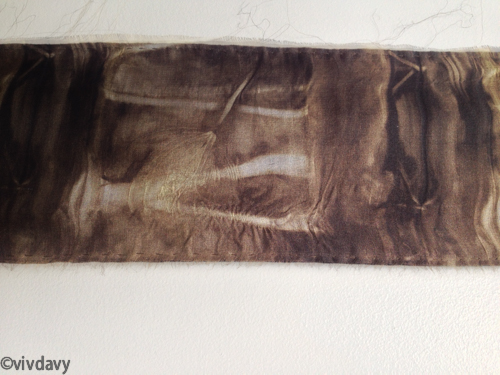
Gallery Statement:
Our life's public archive is created by the daily newspaper. The record of "newsworthy"material marks our passage through society as it informs us. In response, we create the continuing society. This becomes the fabric of our lives, both private and public.
This work was undertaken as a exploratory piece during my Masters In Art and Design. As part of that research I maintained a blog diary of my making. Below are excerpts from the postings I made around creating this work. These notes go into in-depth descriptions about the weaving as it relates to the mundane.
My Blogpost Notes:
The pattern uses 8 different colour warp threads, each colour a section of 3 inches in the reed, or 45 ends. The warp sett was established at 15 ends per inch in the design process.
I have been using this loom for 35 years on and off. For many years it was the place I made my living. The actions and processes necessary to work on this loom are long ingrained tacit knowledge and habituated behaviour. In this aspect they reflect my domestic mundane. Although this process needs an awareness in the precision and counting involved I would suggest that this also happens to a greater or lesser extent with any habituated action in the mundane. Parts of any habituated process will be more automated intellectually than other parts, requiring greater and lesser amount of concentration. Nothing really gets done without some awareness not even the simplest of task such as repetitive sequencing.
The hands have a tactile sense of the smoothness of the threads – necessary for even tension in the weave, the eyes pick up tiny irregularities of colour pattern indicating a tangle. The knowledge of the way the threads need to ‘feel’ in the hand and against the reed to avoid breakages is both tactile and tacit. Textural differences between the yarns are felt in the hands during the sorting process. The test before winding is the opening of the shed to ensure complete separation of all the threads from each other. Tugging and positioning ensures the relaxed but even ‘tension’ on the threads as they are rested on the front beam to wind through.
The work is slow, methodical, another cyclical rhythmic sequence but while still focused on the tiny detailed aspects of the warp threads the physical space is external to the loom working around it from front to back responding to the state of the threads. It draws deeply on tacit and tactile knowledge. The awareness is of process – operational decisions are constantly made but no decisions that would change this process – they have been made and at this stage it is just a matter of progressing through the steps to the point of being able to tie onto the front roller and starting the weaving.
The technique of tearing the newspaper into strips was ineffective so I changed to using the old guillotine that was in the studio, marking out approximately 1 inch spaces across the top of the folded papers and creating the strips to weave that way. This was much quicker and could deliver a more consistent but still variable product to weave with. The weaving began with tabby and immediately the difference from working with yarn or raw wool and working with the paper became apparent. The paper tears on applying pressure, it does not roll easily for the turns which means having to make a concentrated effort on each end of each row to carefully fold the paper and manipulate it into the next row. This makes weaving slow. There is a lot of compression with the beating as well. There is no real opportunity to generate a weaving rhythm with this technique as there is when the weft is inserted off a shuttle. Every piece has to be put in by hand through the warps. These threads are fine and very tight and act like knives, cutting both the paper as well as hands. Extra care has to be taken to avoid the shredding of the paper and also to place it in a way that makes the row as smooth as possible. It is rather laborious.
There is a sense of achievement as the weaving is advanced onto the front roller – visible evidence of energy spent, time invested. This evidence is lasting, tangible, could be defined as a permanent article as opposed to a disposable commodity. How much this resonates with the nature of the domestic mundane can be taken from two perspectives. From one perspective it is possible to say that It doesn’t as most of the ‘chores’ of the everyday are fugitive, often only leaving a trace or an evidence that is not permanent. Often the evidence is in the creation of an absence – e.g. cleaning – the evidence is the lack of dirt. From the second perspective it could be argued that all these invisible chores do leave evidence in the well being of the benefactors of the labour. From a human, not economic, value the care of people and their domestic surrounds so they can enjoy good health in a safe and enriching domestic environment is the indication of how valuable those people are – it is therefore of unlimited value to the recipients.
Each day’s paper has been woven as a unit – marked off on the side of the cloth with a small cotton tag. Some days the paper, of course, has many more pages, especially the Saturday paper so the rhythms of the days are varying. My first paper was dated Friday September 5th 2014. The average time spent weaving each day’s paper is 3 hours a day.

The second week pattern is derived from Helene Bresse’s book. It is a straight draw twill. The text of the newspaper is more obvious in this pattern. The light shifts differently across the fabric. The colour shifts in the warp are clearly visible.There is a sense of movement with the diagonal pattern – it conveys a progression up the cloth that the tabby texture didn’t. The rhythm of the making is made visible.The fine details of the materials are more evident on the surface.
Reflective observations on weaving the straight draw twill.
I enjoy this pattern – it activates the surface enough to be more visually rewarding as a weaver. In this pattern I experience more re-engagement with the content of the newspaper – it triggers my memory of the stories I read when the paper arrived at the house. It therefore is also intellectually stimulating. I also find the sense of flow from the diagonal nature of the pattern rewarding. I can engage with it enough to maintain my position in the sequence, be interrupted or distracted and then easily find my correct position in the sequence. It allows for the engagement with other social aspects of the everyday without needing my complete isolation to achieve it.

Start of week three – change in pattern through altered treadling order of the same tie-up.
General observations on weaving the pointed twill
Immediate need for increased focus and concentration. Less of a rhythm possible because of the increased options in the treadle sequence. This pattern is defined as a 8 harness pointed twill- the treadling sequence goes through the pedals 1-8 in this sequence:1➜8➜1➜8➜1. It is an endless cycle. It is truely cyclical. Weaving this pattern I found required full uninterrupted concentration – distractions were very time costly. Interruptions required a recording of ‘place’ in the cycle to remove the need to retrace where I was in the sequence. The pattern produced is zig-zag. It produces an effect of repetitive backward and forward motion with relatively slow forward progress.
Reflective observations on weaving the pointed twill.
Perhaps of the three patterns this resonates the most with the aspect of everyday mundane tasks like driving to work, school, shops etc and then coming back and doing the same thing the next day etc etc.

The newspaper as a media to ascribe value to the mundane is a good resolution. Old newspaper even though it is our recent history is not valued once it is read except perhaps as fire starter or garden mulch in my domestic arena. Up-cycling this material into a labour intensive form does add evidence of value just on a purely material level. The interesting thing is the transformation into the slivers or shards of our history as each page is ribboned and then compressed. It would be possible to unweave these strips and reassemble the paper which would the have evidence of other uses embedded into its materiality. The entire paper has been woven so in another sense a hidden ‘rescue’ of the record exists now, in the creation of this ‘monument’.
Each of the weaving processes and results talk to different aspects of the everyday. The simplicity of the tabby weave is tedium, easy habituated effort – requiring attention to the finer details to achieve the best possible outcome – to create a site of excellence. Tacit knowledge operates to sense the places requiring focus – the feel of the threads, the angle of placement of the paper strips, the energy on the beater, the amount of advancing at a given roll forward etc. etc. All the differences in using a different weft material in an habituated practice are observed tacitly and concentration focused on those points. This parallels habituated tasks in the everyday if there are contextual changes.
The straight draw twill required more attention but for me it had a resonance with tasks like child rearing, nursing the sick, painting the house, making a new garden. Undertakings where through multiple small actions progress is made forward. I have a sense of the passage forward through life with this weave that I don’t have from the other two types, consequentially to me it resonates with a different aspect of the mundane. It is still a ritualistic cycle of actions to make the outcome, the site is still contained as it is to a large extent in the domestic mundane but the defined diagonal lines read as direction, movement forward – up the length of the weaving.
The pointed twill spoke to me of many things on a very personal level not least of which was the questioning of the use of labour. Over and over again – is this work going to produce an outcome that is worth the personal cost of undertaking it? This, of course, is a constant, largely subconscious, assessment we make about all our mundane tasks – is it worth cooking from scratch when there are take-aways? natural fibre clothing that needs ironing against chemically based fibre clothing that is wash and wear, walking to the shops and carrying home the shopping versus taking the car, etc. etc. Not only was this a question of time consumed by the task but it was also an issue of physical ability to sustain the task.
The total number of day’s newspapers woven into this strip was 17. This consisted of two weeks of 6 days each and 5 days of the third week before the warp was used up. The cut off length of woven papers was a total of 7720mm.
The total number of day’s newspapers woven into this strip was 17. This consisted of two weeks of 6 days each and 5 days of the third week before the warp was used up. The cut off length of woven papers was a total of 7720mm.
Tabby 3860mm
Straight Twill 2130mm
Pointed Twill 1730mm.